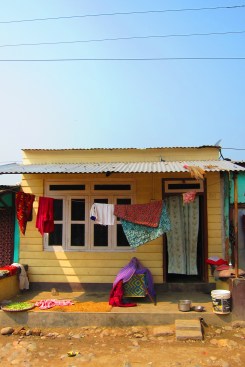
Nepal 2012 – The Home Dedication Ceremony

HFH (Day 10) – Friday, February 24, 2012

Our last day in Bharatpur and a day focused on the house dedication.  The social ambience of the team was a mix of sadness, excitement, and happiness.  For me, the sadness was about the time coming to an end with this team, happiness for the family and their changed life as they move forward, and excitement for the adventures that lay ahead of me.

Our team left for the build site in the morning as per usual.  My expectation was that we would arrive at the build site, do a simple dedication, give our thanks and well wishes to the family and those from community, and depart for the airport.

When we arrived at the site, I was astounded and so touched.  I could not believe the number of people who came out for the dedication.  There was a formal banner announcing the dedication, tons of women from the Amardeep Women’s Cooperative (distinguished by their beautiful blue saris) and dignitaries were in attendance, and there were seats for the guests of honor – which were seats for our team.   Guests of Honor?  Us?  I was so touched.  There were speeches and words of thanks from the various partners, our leader Sherwood, the mayor, and members of the homeowner’s family.  And there were gifts from the Neupane family.  This was totally unexpected, especially since they are so poor.  All of us received tikas.  Women on our team received small traditional Nepalese purses, hair bows and bracelets, and the men from our team looked so grand in their new Nepalese hats. I hope that Richard wears his proudly as he walks the street of Chicago  ;).  So dapper, like the Nepalese men!   From HFH Nepal, there were certificates and a lovely photo of our team.  One could not help but have tears in one’s eyes.  For me, what a significant moment in the family’s life!  They now have a safe, dry, and comfortable house in which to build memories.  The process of cutting the ribbon to the entry of the house took place and photos abounded.  The family looked so happy and the grandmother signalling her thanks with the traditional “Namaste” motion.  It is a memory etched in my consciousness.  While I am writing this (as I catch up on my blog entries) 5.5 months (August 13/12)later, I still have the same emotional reaction of feeling choked up.  I don’t want to lose the memory of this special day.  My emotions of this moment 5.5 months  later testify to the depth of the experience.

Once the formalities were finished, the music and dancing began.  Members of the Women’s Collective and the family cleared the chairs and brought us to our feet to dance.  Drums and singing songs of happiness and gratitude.  It was truly beautiful.

It was time to say good bye.  A difficult time for me as how does one really know how life will turn out.  My optimistic spirit wishes all the best to the family.  Nepal is a very poor country; its’ people rich in character, kindness, and gratitude.  These qualities will surely allow the human spirit to soar, the family to have a better life.  As we walked away from the site, members of the women’s cooperative, the family, community members and children formed two lines leading to our bus to wish us good bye.  That was not an easy walk for me and for those of you who know me, it was done with tears in my eyes.  The refrain of the women to me was “Don’t cry, be happy”.  I was touched and I was happy.   Happy for this opportunity, for all of the lessons of the build and for those lessons to be revealed at a later time, grateful for all those who I met and who will remain with me as a part of this grand adventure.

Namaste….

I hope that my pictures have captured the beauty of the people and  the emotions of the moment.

This slideshow requires JavaScript.

Nepal 2012 – Building Away!

This slideshow requires JavaScript.

HFH (Days 8 & 9) – Wednesday, February 22 & Thursday, February 23, 2012

The days here have been flying by and I am finding it hard to believe that the end of the build is nearing.  Our team has been so amazing!   I have so much gratitude for the positive spirits and attitudes.  It has been great to work with my team members and to have the opportunity to get to know them.  This Habitat for Humanity Nepal build has been so different from the one in Cambodia.  I don’t say this as a critique at all as there were so many awesome things about the HFH Cambodia build.  Here in Nepal,  we are a team of only 16 people who spend approximately 16 hours of the day together.  In total, our team is a bit larger (22) when you include Sujit (our local HFH affiliate contact), Manbdr (the AWC contact) the tradesmen, and our bus driver.  Again, a contrast to the Cambodia build where there were 300+ people from all over the world building 22 houses in 5 days.  In Nepal, we have a routine of working, eating lunch, working some more, showering, eating dinner, drinking, and sleeping.  Days pass quickly and we repeat the routine.  Our team has been discouraged from leaving the hotel in the evening.  I suspect that safety might be an issue.  When we have left the hotel in the evening, it has been to search out pharmaceuticals (all legal I assure you), or money from a nearby ATM.  When we go out after dark for such reasons, we do so in pairs. On the rare occasion when I have left the hotel, the evening life around the market and shops is fascinating, the smells gamey.  There are smells I have never experienced and I am not sure how eager I am to experience them again.  It is not unusual to see whole pigs, heads of animals with hair lying about on tables to be sold.  In search of the pharmacy, I found a room no bigger than the size of a large bathroom and dealing in all kinds of medication.   No prescriptions needed, no questions asked.  Viagra anyone?

Even though we are stationed in a city of over 100,000 inhabitants, there is not much to do here in the evening.  Bharatpur seems to be a poor city with few visible restaurants, theaters, bars, and tourist sites.  These were all things that our HFH Cambodia team had access to in Phnom Pehn.   My sense is that our Nepal team has been okay with sticking around the hotel.  Personally, I did not have any issue with this.   I was grateful for the lack of outside distraction.   The lack of distractions provided opportunities to bond and really forge together as a team. I would do this kind of small scale build all over again.

With respect to our work days, our focus has been tasks related to the plastering of walls. Yesterday we started the process of plastering the inner walls and mapped out the patio.  Day 8 was focused on completing the plastering of the inner walls and the patio, while Day 9 involved the initiation and completion of  the plastering of the outside walls.

We did have a lovely experience of team building with the local community.  During the build, we had to use a lot of water in making our mortar.  At the onset of the build, we had two large oil drums that were filled to their brims with water.  On Day 8, the two barrels were almost empty.  Our dilemma was how to fill the barrels back up with water.  There was no running water in the community or on the build site and the nearest community well was about 750 meters away.  Filling our limited number of buckets and taking them back and forth from the well would have taken a tremendous amount of time to fill the barrels.  We decided to do it the old fashioned way which was to create a line of people from the well to the barrels.  It was kind of like what they did in the old days when there was a fire and no hoses to put the fire out.  I am not sure how many people we had, but our team and community members came together to get the job done.  We had one person start at the well with two buckets of water.  They started the process of walking 25-30 feet to pass the buckets to the next person.  Again, another moment of pride in getting the job done quickly and seamlessly.

As we move forward with each day of work, our physical strength and stamina increase, despite many of us having the typical travel ailments (e.g. forms of Delhi Belly).  Thank goodness for Cipro!  After a week of work, I have noticed that all of us are now able to carry the 50-60 pound bags of sand single-handed.  At the beginning of the build, we had to carry these suckers in pairs.  While I never did master carrying the heavier bags of cement on my own, others got to the point where it was not a problem.  I will leave the build with lean and mean biceps!

Nepal 2012 – The Amardeep Women’s Cooperative

This slideshow requires JavaScript.

 HFH (Day 7) – Tuesday, February 21, 2012

This particular day was a blend of working on the site and making a visit to a local women’s cooperative.

In the morning, we started the process of plastering the walls on the inside of the house.  It was a complicated but physically satisfying job and one of the jobs that I loved.  In plastering, there are numerous steps, the first of which is to throw water at the walls and put a thin layer of cement on the walls.  Following this, a mortar mix is made and thrown at the walls.  Yes, we are throwing dirt.  The water / cement application allows the mortar to stick.  Once a thick layer of mortar is applied, it needs to be smoothed out.  There is an art to making the walls smooth and I have to say that I found my calling.  Good bye psychology and hello masonry!   🙂   Along with several other HFH members who were also drawn to this task, we managed to create walls that were as smooth as drywall.  I was really impressed with the process.  It is amazing at the feelings of pride and satisfaction one experiences in working with one’s hands.   We managed to complete 2 of the 3 rooms on the inside.  Our team also started the process of mapping our and preparing an area in front of the house for a cement patio.  The completion on inside plastering, onset of plastering the outside, and completion of the patio were to be completed on Days 7 and 8. Continue reading

Nepal 2012 – HFH: Day 6

Monday, February 20, 2012

After a weekend of fun, bonding, and some relaxation, we returned to the Habitat for Humanity build site.  Day 6 of the build and we are getting things done!  We were greeted by the homeowner who had such a proud smile on her face.  The roof was on the house!  It had been installed over the weekend and it looked great.  Slowly, the house was coming together and we now had only 5 days to get it completed.  The focus for our team in this second week was on a number of tasks – to finish the walls, to build a concrete patio alongside of the house and to do a general clean up.

On our way in to the build site, there were some strange things observed on the road.  Along the way, we passed groups of children blocking the road with lengths of rope which we had to drive through. Road traffic in front of our site seemed heavier.  As usual, our team started the day with heaps of energy and received instructions on our work tasks.  The work was heavy but satisfying.   Over the course of the morning, our team began to notice the beginnings of a blockade on the main road in front of the house.  I was working on the sand sifting station which was closest to the road and I kept my eye on the happenings.  We all seemed to be increasingly distracted by the gathering semi-trucks, buses, tuk-tuks and people with signs of protest.  I, like everyone else, had little idea as to what the signs said or their purpose.  The traffic eventually came to a standstill.  All lanes of traffic seemed to be facing one direction, and no lanes were moving.  We could hear the chorus of protests.

As lunch approached, we all began to wonder how our bus driver was going to get us out of the site.  As we did not know the fate of the protest, a decision was made by our team leaders to evacuate us from the site and to end the workday at noon.  Our team got on the bus and we made a failed attempt to leave the area.  Traffic moving away from the blockade (which was where we needed to go) was also stopped – it was a gridlocked situation.  A second decision was made, and that was for us to abandon the bus and walk back to Bharatpur.  So, off the bus the 16 of us went, walking along the road, gathering stares of both protesters and people whose only intention was to drive to a destination. We had our lunch at the local women’s community hall and eventually we made our way back to the hotel.   Since we were not returning to the work site, our team had additional time to linger in the neighborhood and go down the the river.  Sherwood, our team lead, entertained some of the locals with his card tricks.  This was a delight.

Once we left the women’s hall, we arrived at the hotel to find that the windows were completely shuttered and the power was out.  Apparently, there were concerns about the blockade, protests and the possibility of things becoming more heated, possibly violent.  Our instructions were to not leave the hotel.  We sat it out and by 4 pm, power was on and shutters were up.

What was the protest and blockade about?  We later learned that a 12-year old boy was shot by police that morning in Bharatpur. People were angry and out protesting the sad outcome.  I don’t know whatever happened following this, but I often think about this and feel for the family and community. 

This slideshow requires JavaScript.

Nepal 2012 – Chitwan National Park

This slideshow requires JavaScript.

 Saturday, February 18 & Sunday, February 19, 2012

Our Habitat for Humanity team successfully finished our first week building the house.  We left it with the walls completely constructed and with all door and window frames in place.  Over the weekend, our trades people would be installing the tin roof.  I felt that the team left the project on Friday feeling a sense of pride and connection to each other, the family, project and surrounding community.  It was not time for some R&R on the weekend.    As a team, we all decided to use our free weekend to travel to Chitwan National Park.  Bharatapur, the city in which we were stationed, sits close to the border of CNP.  CNP is located in the south lowlands (the Terai) of Nepal and is pretty close to the border of India.

Our team travelled to Chitwan where we stayed in a lodge within the confines of the Park.  Chitwan, Nepal’s first national park, was established in 1973.  Prior to its establishment, it was hunting grounds of Nepal’s ruling class.  It’s seen a lot of damage.  One of the stats I read was that at the end of the 1960’s 70% of its  jungles were eradicated through the use of DDT.  As one can imagine, it was totally destructive to the habitat of many animals who live in that area. CNP is the home of  the Bengal tiger (it has one of its best habitats in the world)  and the one-horned rhino.  At the end of the 1960’s, only 95 rhinos remained. Continue reading

Nepal 2012 – HFH: Days 4 & 5

This slideshow requires JavaScript.

Thursday, February 16 and Friday, February 17, 2012.

On days 4 and 5, it was great to see the progress on the house. Our walls were rapidly rising with the window and door frames being installed. The goal of the team was to have all walls finished by the Friday. We had to accomplish this goal so that the corrugated tin roof could be installed on weekend and walls readied for the plastering during the second week.

The work has been hard but satisfying. What I have loved about this team is that everyone is engaged and trying out all of the different building tasks. From carrying bags of cement to sifting dirt for the mortar, all tasks are important and I have learned so much. I am totally in the moment of building, but thinking ahead in regards to how I might continue to make a difference.

I have had such a sense of pride and accomplishment in being a part of the HFH GV team. While we are building a house for a well-deserved impoverished family, I have also gotten so much out of this build as well. There is the exchange of culture and learning about the Nepalese; the connection with the locals and the receiving family who have welcomed us with open hearts; and the appreciation for how much we have and how little they have.

In building the house, I have thought a lot about my dad, his impoverished childhood, the sacrifices he made to come to Canada and all of work he and my mom did to house, feed and educate their children. Parents here are no different, as they desire only good things for their families – shelter, nutritious food, a safe environment, education. The homeowner here has made sacrifices that will bring a solid home and a different future for her family.

On the weekend, the tin roof will be installed and the second week will be spent plastering the inside and outside of the house and building a cement patio.

Here are a some photos from days 4 and 5.

Nepal 2012 – HFH: Days 2 & 3

This slideshow requires JavaScript.

It was exciting to finally arrive on the build site. We were greeted by the family and community members with huge smiles, tikas, and an abundance of flowers. All that was present at the site was a concrete slab set on a foundation of large rocks. Our task: to build a solid home!

Our family of 5, led by a widower named Kamala Neupane, lives in what I estimate to be a 10×10 foot shelter, not bigger than some garden sheds on our properties.  Their home is made up primarily of corrugated tin sheets, plywood, and has a dirt floor.  Our team was given the opportunity to see the inside of the family’s home.  Inside there was a double bed, sleeping mats, and some counters/storage.  A single electrical cord led from the power pole to the inside where it was connected to a small television.  My thought was this could not be safe for them, especially during the monsoon season when water probably floods their home.  Water and electricity do not mix.  Additionally, there is no proper sanitation nor running water at their home or in the community.

We were given a rough idea of what we had to do and all of the tasks needed to get the job done. Our tasks included moving 30 pound cement blocks onto the foundation, sifting rocks and stones out of a gravel mix to create sand, bagging and transporting sand and cement, mixing mortar and laying bricks. These were the tasks of the first few days. We have few tools –  three shovels, buckets, a hammer or two, trowels, string for keeping things level, and of course, our hands and muscles.

At the end of these first two days of work, I was so impressed with the team’s ability to come together for a common cause. Like any team coming together, we are finding a rhythm of work. It feels pretty seamless.  I love the experience of bonding with new people and doing it over building something so simple as a wall. In this case, the walls were not barriers, but a way to bring people together. Conversations and getting to know each other have made the work days pass by so quickly.

When we arrive on site, we are greeted like rock stars. Every morning children and adults greet the bus. It’s so awesome to be greeted with their enthusiasm and appreciated for the work.  I feel as if the home will really make a difference.  There is so much gratitude.  In between our work, we have become acquainted with the local children. They are hilarious, love to practice their English and are more than willing to pose for pictures. “One picture please” is a common refrain.

The home owner and family are involved on the site and are very observant of our work. Krishna, the 16-year old son, has been attending closely to our work and you can see the pride he has. It was easy to identify which room of the home would be his from the time he was spending in one of the room.  I caught him touching the wall of it in an admiring fashion.  Someone on the team asked him which room was to be his and my assumption was correct. Krishna is only 16 and I just can’t imagine what it must be like for a person that age to be living in a 10×10 room with 4 other adults. He will surely enjoy his new space.

I have a few pictures that show our progress of the first two days.

Nepal 2012 – HFH: Day 1, Departure for Bharatpur

Monday February 13, 2012

I have been anticipating this part of my trip for a long time and am tickled to finally be at the build site.

Our team arrived from Katmandu (K-Du) on the ‘brain shaker’, a small 18-seater plane. I can’t remember the last time I was able to watch pilots doing their job in the cockpit or being thankful for our safe landing.  It was a whoozy ride for me but I was happy to arrive and begin the build.

Our HFH team is stationed in Bharatpur, a small city on the edge of Chitwan National Park. Bharatpur is located in the lowlands of Nepal and sits at a considerably lower altitude than K-Du. Where K-Du is located at about 1000m, Bharatpur is only at 100m. It is significantly warmer and definitely flatter than other parts of Nepal.

The project that we are working on is on the edge of the city, in a community that is very poor. Most houses appear to be one room shelters – some wooden, some made of concrete blocks or bricks, and some a jumble of materials put together in an apparently random fashion. To date, Nepal is the poorest country I have visited and Bharatpur, the poorest city.

Sujit Maharjan, the HFH Nepal contact, met with us to give a bit of an orientation to the build, the family for whom we are building, and construction processes, safety considerations. Our family of 5 is led by a widower named Kamala Neupane.  The home she currently lives in provides shelter for herself, two sons (ages 16 & 17), and two daughters (I think that they are around 21 and 22).  The daily wage of those working in the household is 100 rupees (approximately $1.50USD) per day. This is not a lot considering that I bought a new pair of hikers in KDu that were the equivalent to one month’s worth of wages and I did so without putting a lot of thought onto the price. My description of the site is bland to what one sees on the site. It’s a pretty impoverished family.  Immediately, I am grateful for what I have.  We take things for granted.

Our team of 16 is a bit of a motley crew. I love it! There is a varsity basketball coach, a NYC model, hedge fund manager, software developer, retired army member, physician’s assistant, architect, and civil engineer, to name a few. We come from NYC, Boston, Chicago, Kentucky, California, Minnesota, and Arizona. Once again I am the lone Canadian, which I don’t mind at all. I’m trying to be an example of a great Canadian.  Please pass the beer and poutine eh.  😉

We are building a 3-room home which is split up so that each room has a window and its own entry. None of the rooms are linked to each other. It kind of reminds me of row housing we built in Cambodia. The homeowner had the option of making the home into one entire room, but she opted to design it into three rooms.  My understanding is that when the house is built, Kamala’s mother will join them.  They will live in the first room; the daughters will occupy the second room; and the sons will have the third room.  In Nepalese culture, daughters leave the home when they marry and sons bring their brides home.  In this case, when the daughters eventually marry, each son will have a private space for him and his wife.  There will be no kitchen built.  They will cook outside at the back of the house.  When and if the  homeowner has funds, she will put in a cement pad for the kitchen.

We are a keen group and all are excited to let the building begin! 

This slideshow requires JavaScript.